Redline walkthrough, all on one page
Know what a subcontract can cost you before you sign it.
Ten steps, top to bottom. Every screen is the real product, shown on a fictional job.
Chapter 1. The problem · Step 1 of 10
The contract isn't the job you priced
You priced the scope, the schedule and the payment terms. Then the GC sends their subcontract. Their side wrote it, and it quietly changes all three. It usually lands on a project manager who reads it at night, between everything else, with nobody to say what's normal.
Sound familiar?
Five sentences from one subcontract
These are from the fictional subcontract this walkthrough follows: Copperline Flooring, a flooring sub, on a $1,860,000 job for Brookfield Ridge Builders. Each one reads like boilerplate. Each one moves money from your side of the table.

1.1The Subcontract Documents consist of this Agreement, the Prime Contract between Contractor and Owner, the General Conditions, the Project Manual, the Drawings and Specifications, and the Project Schedule, all of which are incorporated by reference as if fully set forth herein. Subcontractor is bound to Contractor to the same extent Contractor is bound to Owner.
What it means for you: You're bound to the prime contract, and to everything the GC owes the owner, whether or not anyone handed it to you.
3.2Payment to Subcontractor is contingent upon Contractor's receipt of payment from Owner. Subcontractor assumes the risk of owner nonpayment.
What it means for you: If the owner doesn't pay the GC, you don't get paid. However good your work was.
3.4Contractor shall retain ten percent (10%) of each progress payment until final completion of the entire Project.
What it means for you: Ten percent of every payment is held until the whole building is finished, not your scope.
4.2Subcontractor shall pay Contractor liquidated damages of $2,000 per day for each day of delay attributable to Subcontractor.
What it means for you: No cap. Enough days of delay and the profit on this job is gone, then you're paying to work.
4.5Subcontractor shall give Contractor written notice of any claim for additional time or compensation within seven (7) days after the event giving rise to the claim. Failure to give such notice shall constitute a waiver of the claim.
What it means for you: Seven days to put a claim in writing. Miss it and a valid claim is waived.
Why it keeps happening
It isn't carelessness. It's the setup.
The other side wrote it
A subcontract is the GC's paper, written to move risk off the GC. That's their job. Somebody has to read it for yours.
There's never time
Bids are due, the job is starting and the GC wants it back signed. A careful read takes hours nobody has that week.
A lawyer on every contract doesn't pencil
Attorney review is billed by the hour and takes days. So most contracts get a quick read and a hope, and the expensive clauses get found on the job.
“What am I missing?”
Every sub who has signed a contract has asked it. You shouldn't lose the profit on a good job to something buried in the contract.
Chapter 1. The problem · Step 2 of 10
What one contract can cost you
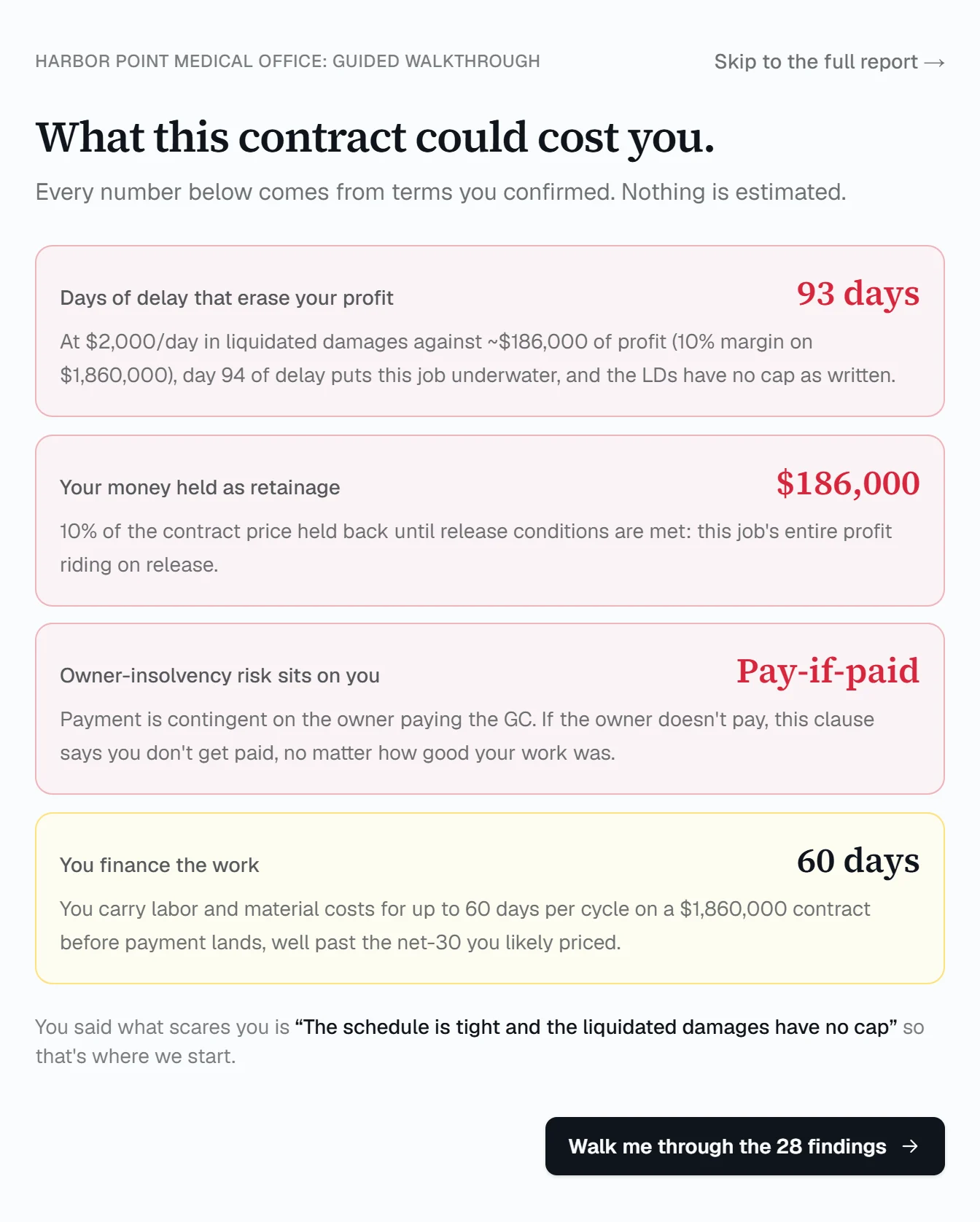
On paper those clauses look routine. In dollars they are not. This is Redline's own cost screen for the Harbor Point job: a $1,860,000 flooring subcontract, using the 10% margin the sub entered.
Harbor Point, in dollars
93 days of delay and the profit is gone
This is the first screen of every finished review, before you read a single finding. It turns the clauses into the numbers you run a business on.
- 1
Nothing is estimated
Every figure comes from the contract's own terms and the answers you gave: the price, your margin, the LD rate, the retainage, the payment days. - 2
It starts where you're worried
Tell Redline what keeps you up about a job and the review opens there. Here, the sub said the schedule is tight and the LDs have no cap. - 3
Then the fix
From this screen it walks you through every finding, worst first, with the replacement language ready.
The arithmetic
Redline on this contract: $399. The profit riding on it: about $186,000.
It doesn't have to save every contract. It has to catch one clause like these before you sign it. And it doesn't replace your attorney: it makes their hour count, because they start from the issues that matter instead of page one.

Across the industry
The best construction dispute is the one you never have.
$60.1M
Average value of surveyed North American construction disputes, 2024
12.5 months
Average time to resolve
#1
Contract and specification reviews, ranked the most effective claims-avoidance technique
Source: Arcadis Global Construction Disputes Report. Averages of surveyed disputes; yours doesn't need to be that size to wipe out a job's profit.
Chapter 2. What Redline does · Step 3 of 10
One upload, back in minutes
Drop in the GC's subcontract and your proposal, plus the prime contract if you have it. Redline reads all of it against your company's standards and the law in the project's state. The 101-page showcase contract took three minutes 14 seconds.
One review, one screen
Everything about the contract, in one place
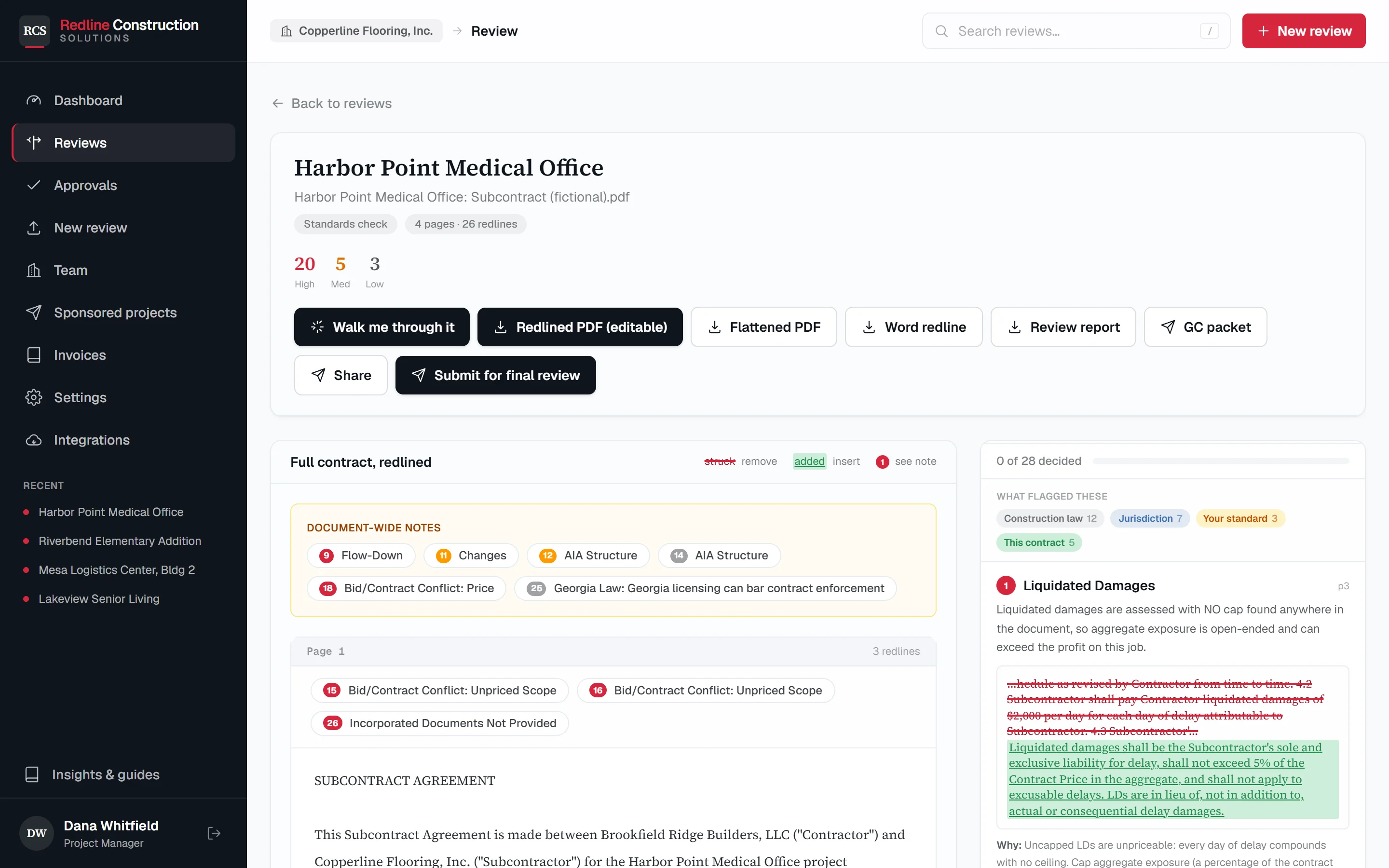
This is a finished review of the Harbor Point subcontract. The whole contract, already marked up, with every issue beside it and every file you'll need one click away.
- 1
The score at the top
20 high, 5 medium, 3 low. You know how bad it is in one look. - 2
Your files, ready
Redlined PDF, Word redline, the review report and the GC packet. - 3
The contract, marked up
Struck and rewritten where the problems are, with the reasons on the right.
What comes back
Five things, every contract
Every clause that can cost you
Ranked by risk, each with the page, the reason and replacement language. Harbor Point: 28 findings, 20 high risk.
See it 2What it could cost, in dollars
Days of delay that erase your profit, money held back, who carries the owner's credit risk.
See it 3The contract, marked up to send back
Word tracked changes, a marked-up PDF and a clean list of asks for the GC.
See it 4Every deadline, on one card
The clocks the contract starts on day one, printed for the people on site.
See it 5A clear verdict before signing
One honest answer to whether it's ready to sign, and a sign-off on the record.
See itIt learns your company once
Your rules, applied to every contract
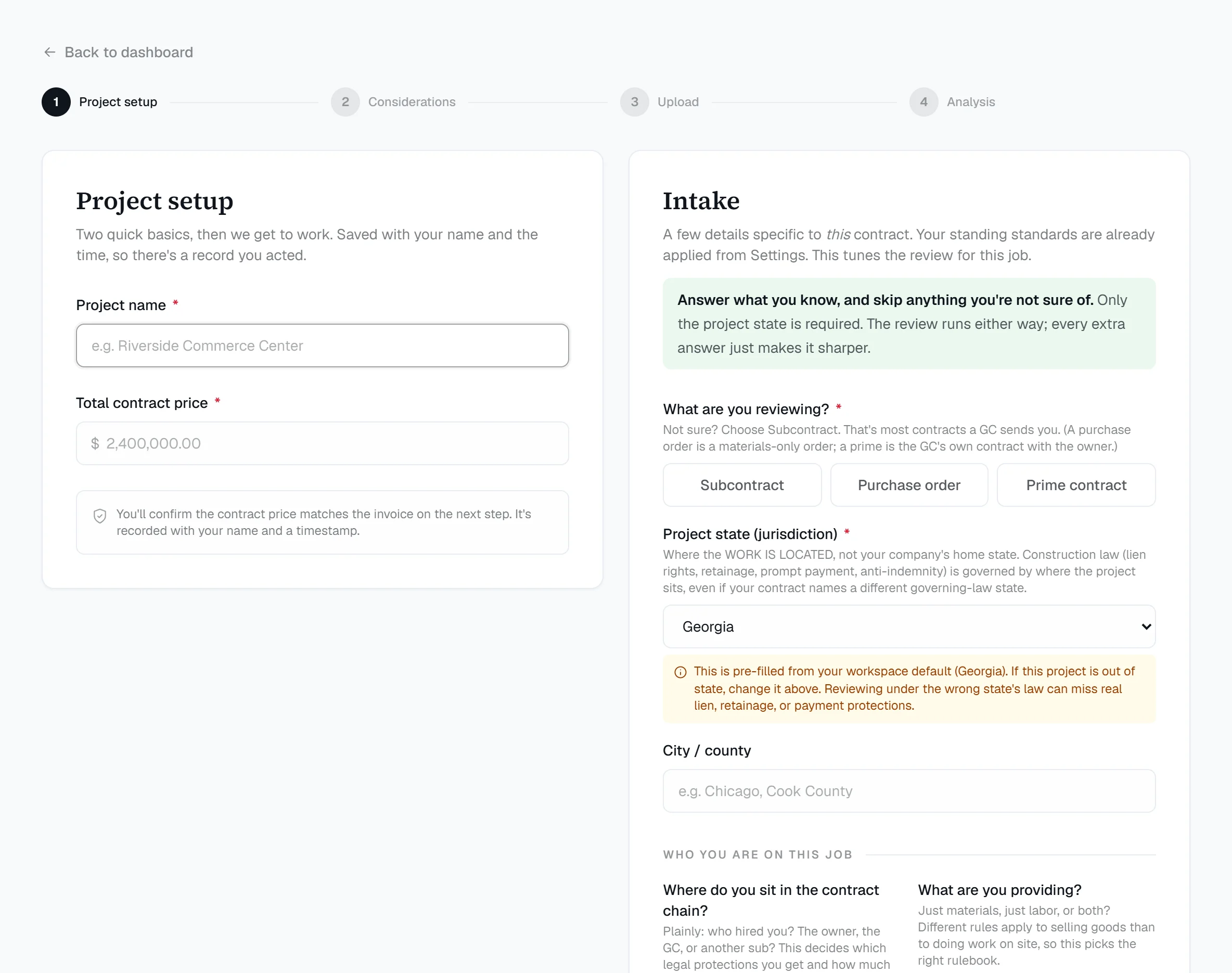
Tell Redline your trade, which side of the table you're on, your home state, your standard positions and insurance, and who signs off. Every contract after that is read against them, so a new PM checks a contract the way your best PM would.
Starting a review then takes two basics and the files.
What it is, and isn't. Redline is not a law firm and doesn't give legal advice. It's the first read, not the last word: it finds, prices and drafts, and your team and your counsel decide.
Chapter 2. What Redline does · Step 4 of 10
Every problem, marked on the contract
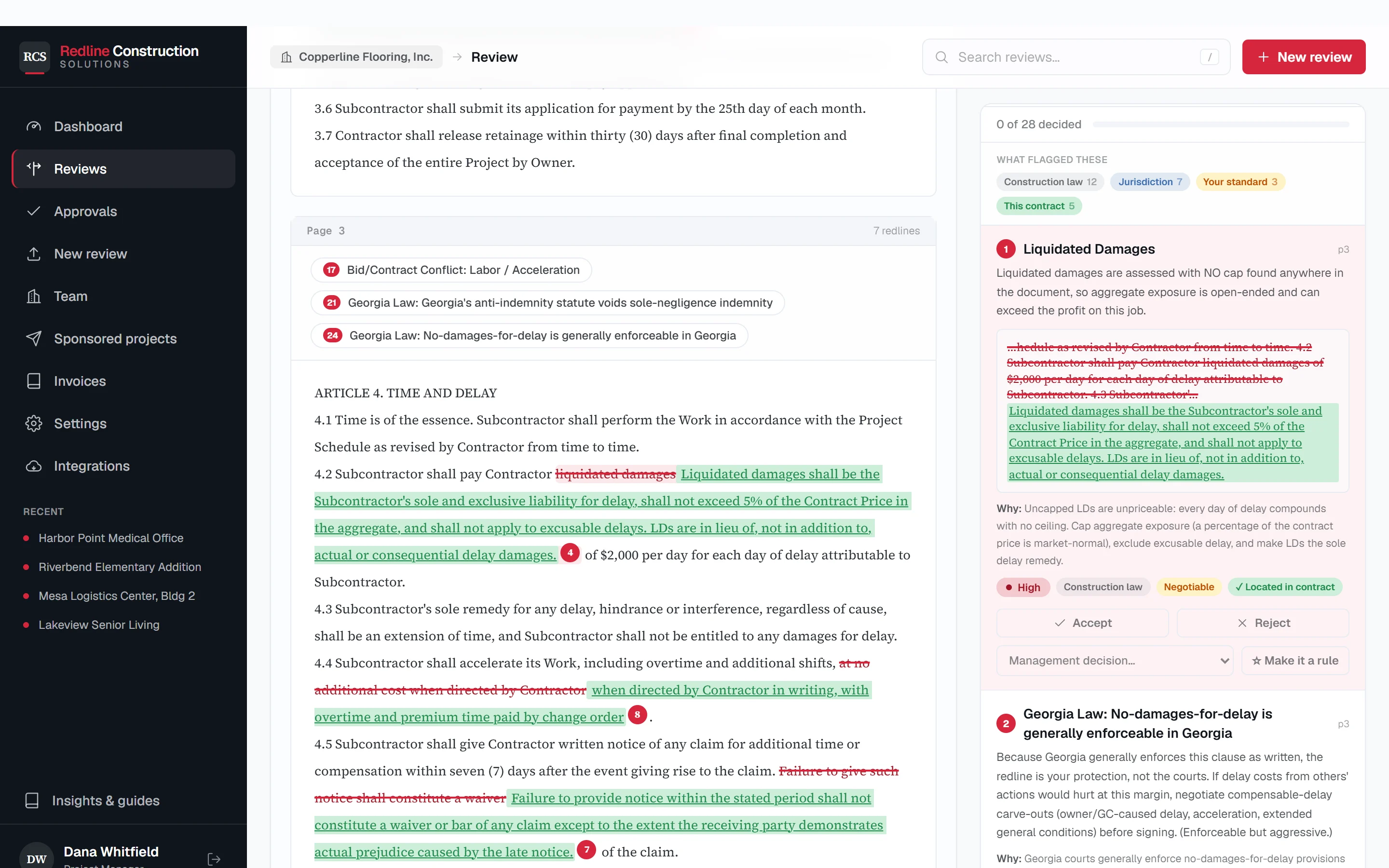
No separate memo to cross-reference. Each issue is struck and rewritten on the contract page it came from, with the reason beside it, so you see exactly what you'd ask for and can decide in seconds.
- 1
Red is the contract's words
Struck through where they sit, on the page they sit on. - 2
Green is the fix
Replacement language written to drop straight into the document. Here: LDs capped at 5% of the price, the sole remedy for delay, and no LDs for excusable delay. - 3
The reason, in plain English
Why it matters on this job, beside every change.
- 4
Where the flag came from
Construction law, the project's state, your own standard, or a conflict inside this contract. Every recommendation is traceable. - 5
Your call, on the record
Keep or drop the language, then decide the business side: negotiate, price it into your number, insure it, get it clarified, send it to counsel, or walk away.
Also on every review
The things a quick read never catches
Your bid against the contract
Scope you didn't price, exclusions the contract erases, a price that doesn't match. Harbor Point: 5 conflicts.
Documents you were never given
The prime, exhibits and specs the subcontract binds you to by reference.
The law where you build
Pay-if-paid, anti-indemnity, lien and retainage rules for the project's state. Harbor Point, Georgia: 6 state-law findings.
Insurance it requires
Limits and coverages the contract demands, against what you actually carry.
Chapter 2. What Redline does · Step 5 of 10
What you send the GC
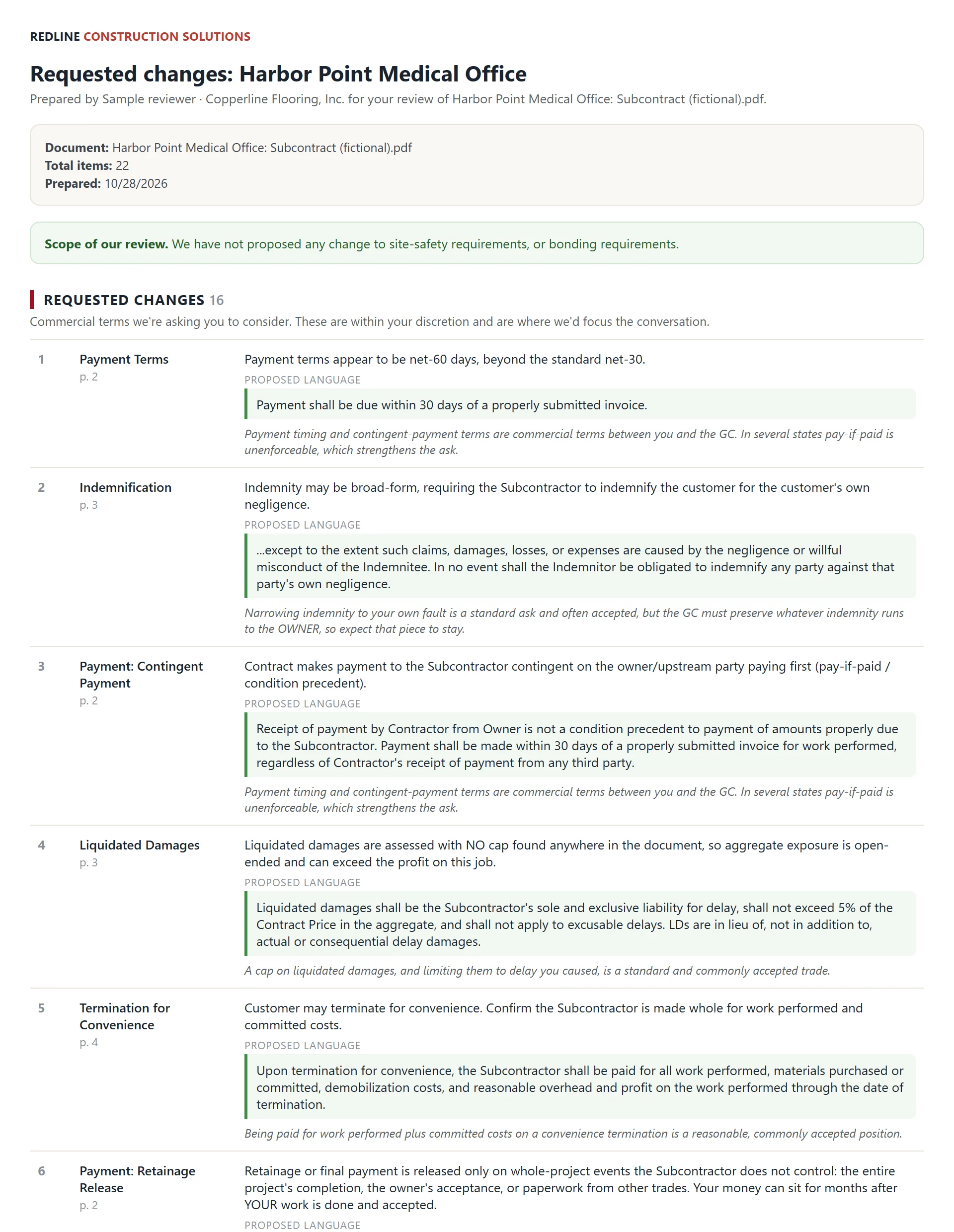
When you've made your calls, Redline writes the ask. The GC gets one clean list: what you want changed, the language, and why. You also get your redline as Word tracked changes, the format their PM already works in, and a marked-up PDF.
The GC packet
Professional, specific, and easy to say yes to
- 1
Only what you decided to push
Anything you accepted, priced or insured stays out. The GC sees your asks, not your internal debate. - 2
Language they can sign
Each request carries the replacement wording and a one-line reason. - 3
Word and PDF too
Tracked changes for the GC's attorney, a marked-up PDF for everyone else.
For your team and your attorney
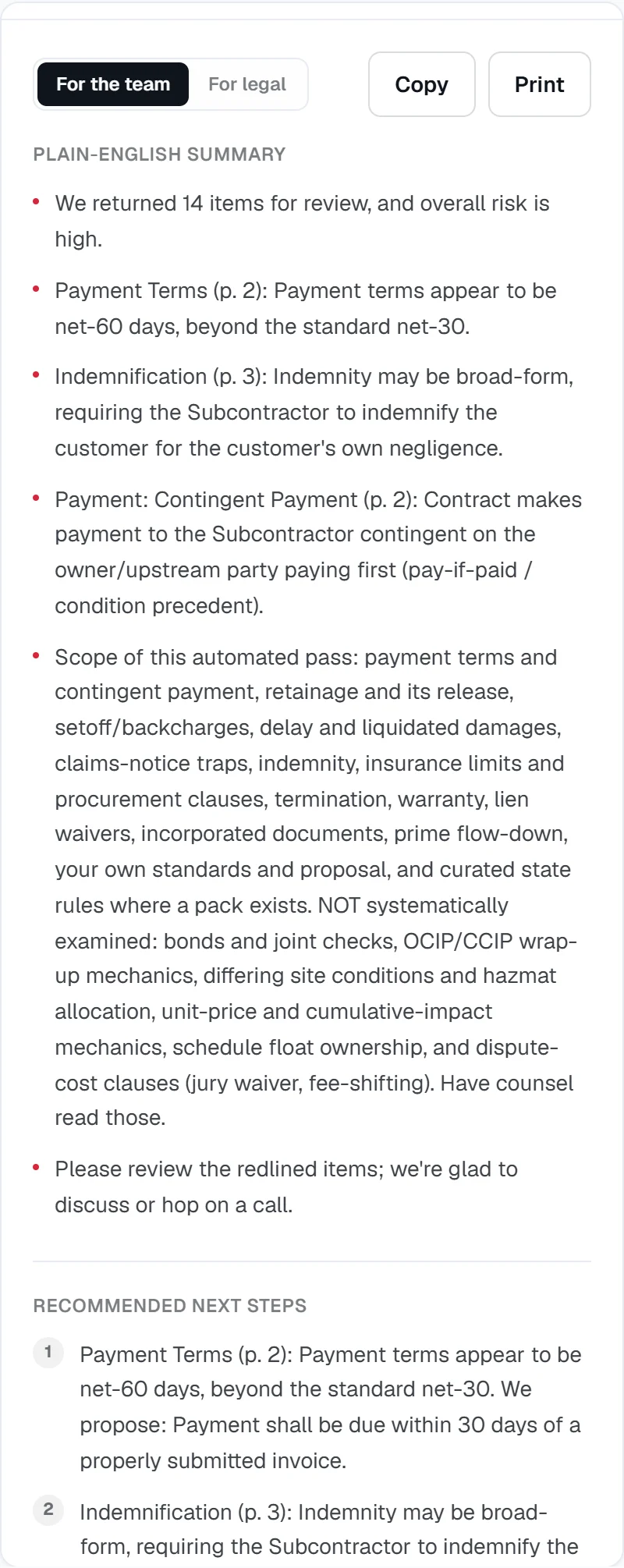
A summary in plain English, and one written for legal
Every review has a short summary for the team and a version for counsel. When something needs your attorney, send the issues that matter with the context, so their hour goes to judgment instead of reading.
Share the files with anyone who needs them, with no login on their side.
Chapter 2. What Redline does · Step 6 of 10
Every deadline, for the field
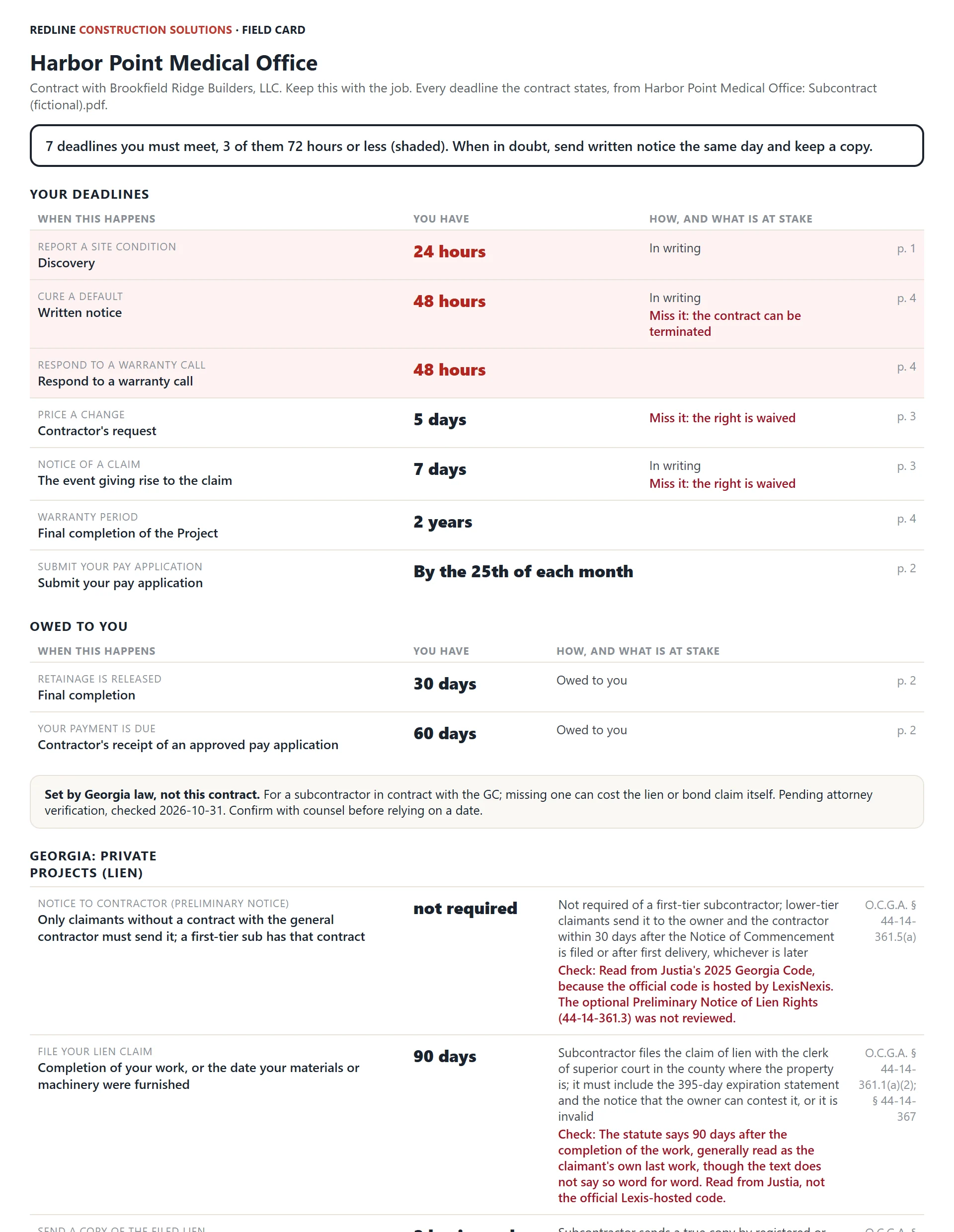
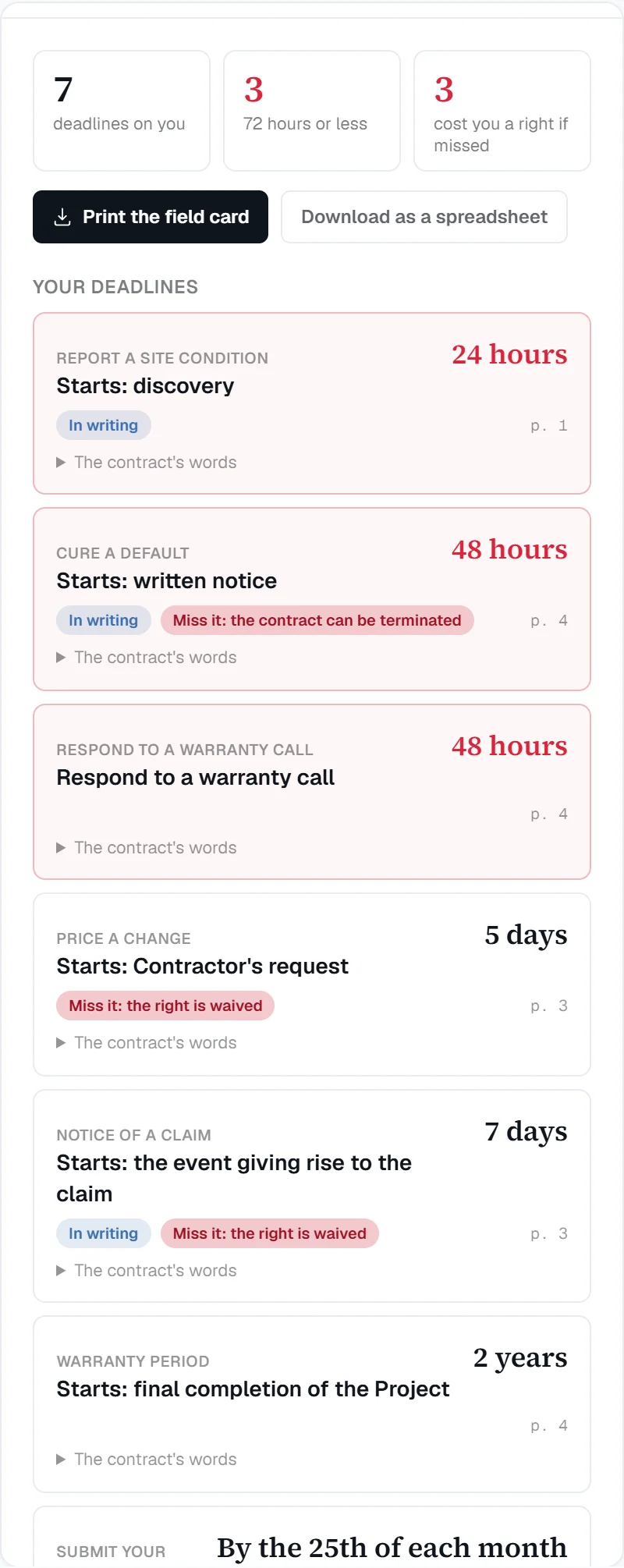
A review ends at signing. The contract doesn't. From day one it runs clocks: report a hidden condition in 24 hours, price a change in 5 days, give notice of a claim in 7. Miss one and a valid claim can be gone. Redline pulls every clock out and puts them on one card for the field.
The field card
One page for the superintendent's truck
Harbor Point has seven deadlines the sub must meet. Three of them are 72 hours or less, and three cost a right if they're missed. Each one shows what starts the clock, how long you have, how notice has to be given, and the page it came from.
- 1
What's owed to you, too
When retainage has to be released and when payment is due, so you know when to push. - 2
The prime contract's clocks
When you upload the prime, its deadlines are listed separately. - 3
State lien and bond deadlines
Set by law, not the contract, for 12 states so far. Each is cited to the statute and marked pending attorney verification.

Chapter 2. What Redline does · Step 7 of 10
A clear yes or no before anyone signs
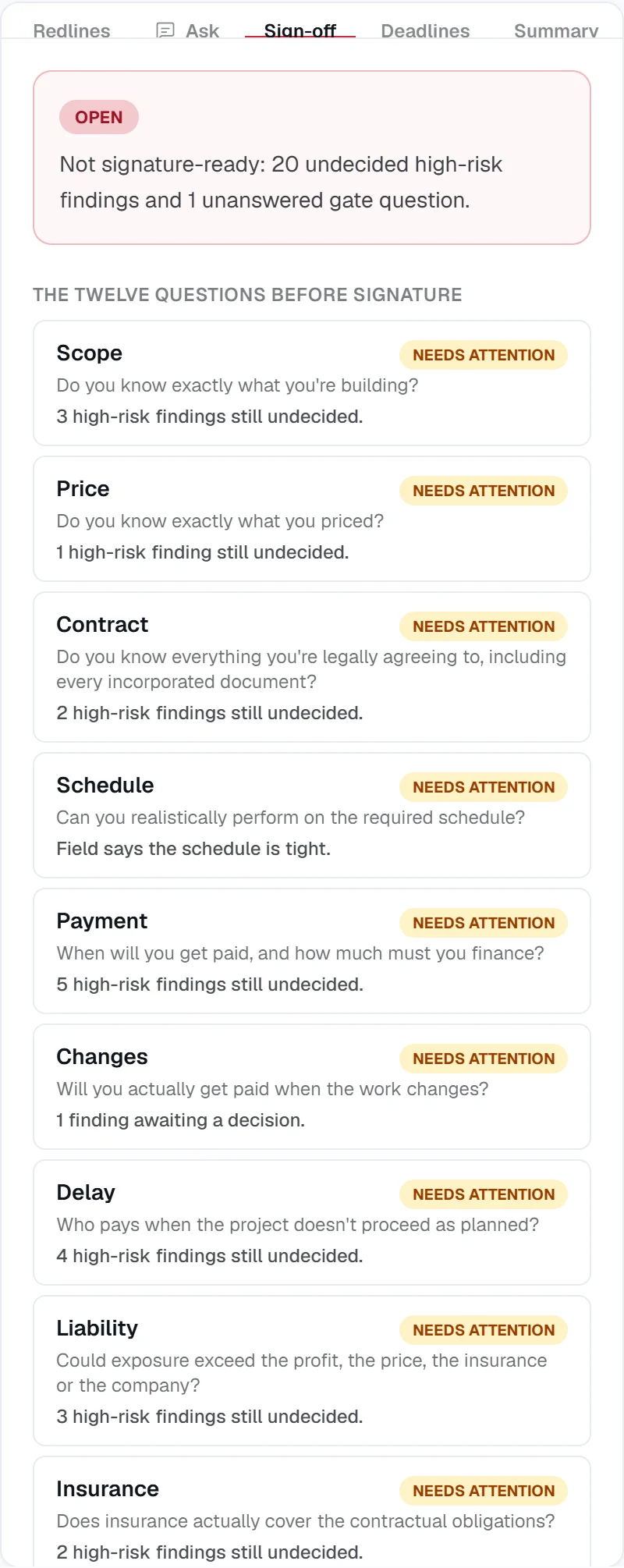
Before anyone signs, Redline answers the twelve questions every contract has to answer: scope, price, payment, schedule, changes, delay, liability, insurance and the rest. It gives one honest verdict, and the person you choose signs off, on the record.
The sign-off gate
Not signature-ready until the big ones are decided
Harbor Point today: Not signature-ready: 20 undecided high-risk findings and 1 unanswered gate question.
- 1
Twelve questions, answered from the review
Each one marked clear or needing attention, with what's still open. - 2
Your approver signs off
Submitted reviews wait in an approvals queue with a target time, and an overdue one is flagged. - 3
The copy you sign is checked
Upload the execution copy and Redline compares it to what you agreed, so a term that quietly changed back gets caught before the signature.
Every contract, one log
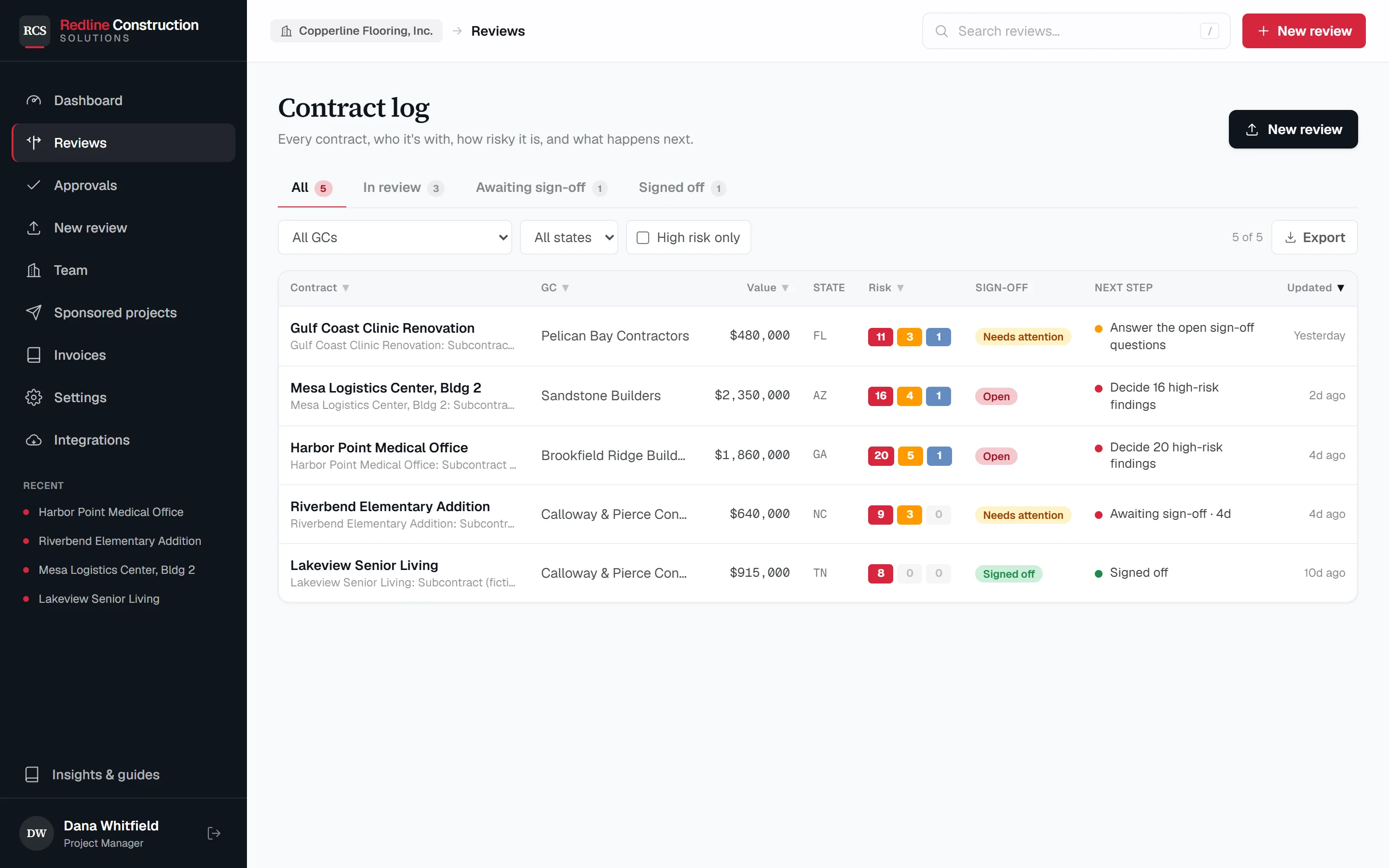
Where every contract stands, without asking anyone
The GC, the value, the state, the risk, whether it's signed off and what has to happen next, for every contract your company has in front of it. Sort it, filter it by GC or state, and export it.
Chapter 3. Why Redline · Step 8 of 10
Why not sign it, call the lawyer or ask ChatGPT?
Most subs handle a contract one of three ways today. Here is an honest side by side, and where Redline fits with your attorney rather than instead of them.
What it costs
Redline: $399 a contract, or a plan
- Sign it as is
- Nothing up front
- Attorney on every contract
- Billed by the hour
- Ask ChatGPT
- A subscription
How fast
Redline: Minutes
- Sign it as is
- Today
- Attorney on every contract
- Usually days
- Ask ChatGPT
- Minutes
Checks it against your bid
Redline: Yes, every time
- Sign it as is
- No
- Attorney on every contract
- If you send it and ask
- Ask ChatGPT
- If you paste it in and ask
Knows your company's standards
Redline: Yes, set once
- Sign it as is
- Only if you remember them
- Attorney on every contract
- If you brief them
- Ask ChatGPT
- If you explain them each time
Knows the law in the project's state
Redline: Yes, cited, with a plain flag where a state isn't covered
- Sign it as is
- No
- Attorney on every contract
- Yes
- Ask ChatGPT
- In general terms
Marks up the actual contract
Redline: Yes: Word, PDF and a GC packet
- Sign it as is
- No
- Attorney on every contract
- Yes
- Ask ChatGPT
- No, it writes about it
Lists every deadline for the field
Redline: Yes, on a printable card
- Sign it as is
- No
- Attorney on every contract
- If asked
- Ask ChatGPT
- If asked
The same check on every contract
Redline: Yes
- Sign it as is
- Depends who reads it
- Attorney on every contract
- Depends who reads it
- Ask ChatGPT
- Depends how you ask
| Sign it as is | Attorney on every contract | Ask ChatGPT | Redline | |
|---|---|---|---|---|
| What it costs | Nothing up front | Billed by the hour | A subscription | $399 a contract, or a plan |
| How fast | Today | Usually days | Minutes | Minutes |
| Checks it against your bid | No | If you send it and ask | If you paste it in and ask | Yes, every time |
| Knows your company's standards | Only if you remember them | If you brief them | If you explain them each time | Yes, set once |
| Knows the law in the project's state | No | Yes | In general terms | Yes, cited, with a plain flag where a state isn't covered |
| Marks up the actual contract | No | Yes | No, it writes about it | Yes: Word, PDF and a GC packet |
| Lists every deadline for the field | No | If asked | If asked | Yes, on a printable card |
| The same check on every contract | Depends who reads it | Depends who reads it | Depends how you ask | Yes |
“Can't I just ask ChatGPT?”
Yes, and you'll probably learn something.
But reading the contract isn't the hard part. Knowing what to compare it against is. The difference isn't the AI. It's everything Redline knows before the AI starts: your bid, your standards, the rules in the project's state, and every clock in the contract. You don't need to know what to ask. Redline does.
And your attorney?
Still in the room, and better used.
Redline is the first read, not the last word. It isn't a law firm and doesn't give legal advice. What it does is put the issues that matter in front of your attorney with the context and proposed language, so the hour you pay for goes to judgment instead of reading.
Your contracts are confidential
What happens to what you upload
- Encrypted in transit (TLS 1.2 and up) and at rest (AES-256).
- Stored under a key scoped to your company, and never used to train AI models.
- On the free check, your file is deleted as soon as it has been read.
- Workspace contracts stay until you ask for them to be deleted.
SOC 2 is planned; there is no SOC 2 report today. The full security page.
Chapter 3. Why Redline · Step 9 of 10
For GCs and owners
Everything so far is the sub's side. The same review works from the other side of the table. A GC can give every sub on a job's bid list a free review of the GC's own subcontract and get one clean page of asks back from each, before buyout instead of after mobilization. An owner can require it across a project.
- 1
Send the bid list one link
Each sub reviews your subcontract on their side, free to them. Nothing for your team to install or learn. - 2
Asks come back as one page each
Instead of a dozen markups in a dozen styles, every sub sends the same clean format: what they want changed and why. - 3
Settle it at the table
Work through the asks before anyone signs, so the problem a sub would have found in month four is handled in week one. - 4
Their review stays theirs
You see where each sub stands and what they ask for. The sub's private review of your paper stays private to them.

Priced per job
One price for every subcontract on the job
| Project value | Program price | Of project value |
|---|---|---|
| Under $10M | $7,500 | ≤ 0.08% |
| $10M to $50M | $15,000 | 0.03 to 0.15% |
| $50M to $150M | $30,000 | 0.02 to 0.06% |
| $150M + | Custom | Varies |
A qualifying founding job or project runs free, with no commitment beyond it. See the GC page or the owner page, or tell us about a job heading into buyout.
Chapter 4. Working with us · Step 10 of 10
How to start working with us
Start on a contract you actually have. Here is exactly how working with us goes, what it costs, and how to reach a person.
Three steps
From your first contract to your whole team
- 1
Run one contract free, today
At redlineconstructionsolutions.com/free. No account and no card. You see how many findings there are and the first one in full; leave an email for the rest.
Run a contract free - 2
Use the two-week trial
Up to three contracts in 14 days, for your whole company, with every file: marked-up PDF, Word redline and GC packet. More versions of the same contract don't count against it.
Start the trial - 3
Pick how you pay
Per contract when it's occasional, or a plan when it's weekly. At two contracts a month, Core costs about the same as buying them one at a time.
Full pricing
What it costs
Pay per contract, or a plan
One contract
$399
No subscription. Every check and every file.
Three-pack
$999
Three contracts, used when you need them.
CoreMost firms
$999/mo
or $799/mo billed annually
100 contracts / year, 5 users.
Scale
from $1,999/mo
or $1,599/mo billed annually
300 contracts / year, 15 users.
Enterprise is custom. GC and owner programs are priced per job. Core includes everything in this walkthrough.
Setup
One sitting, then it's yours
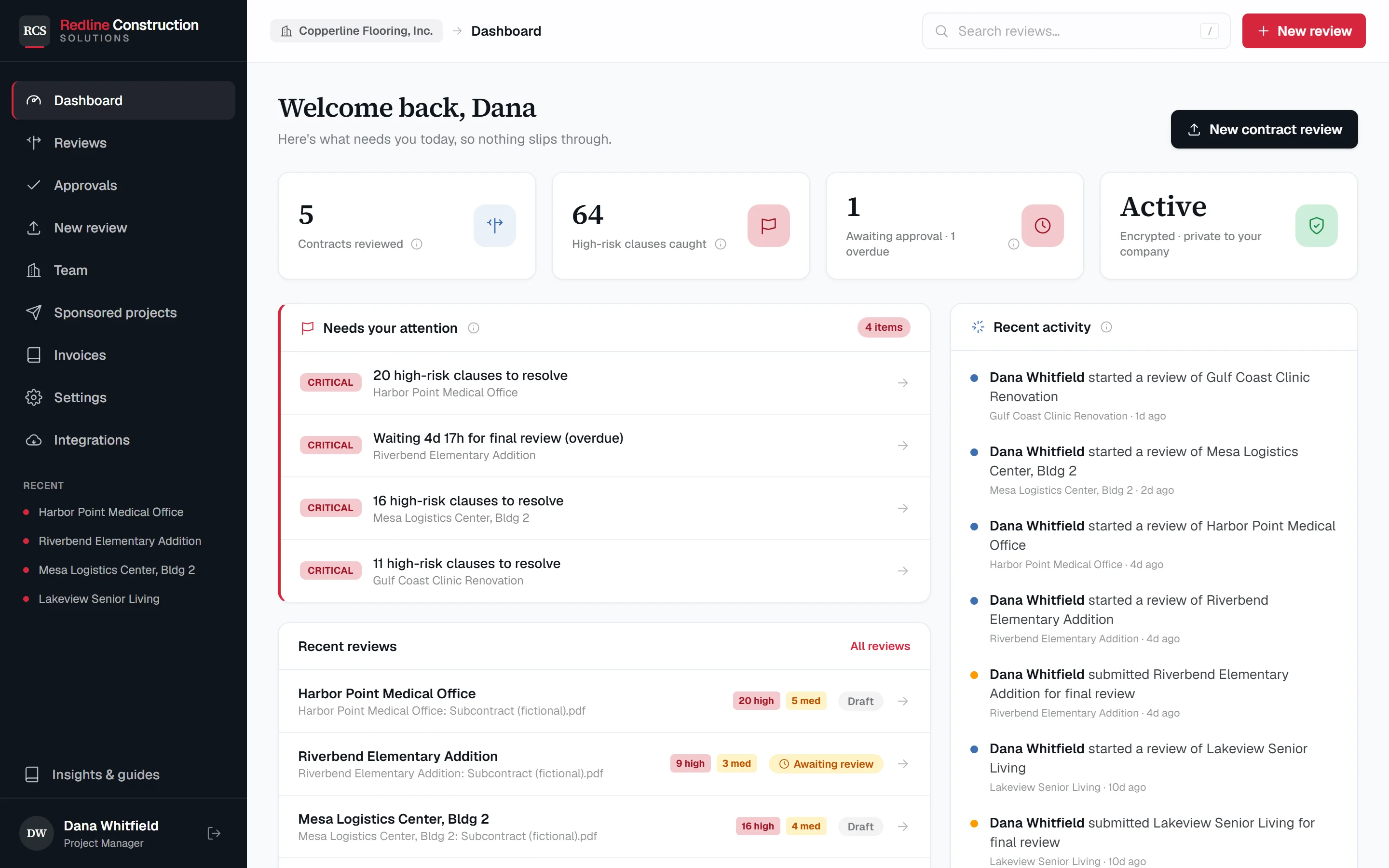
Your trade, which side of the table you're on, your home state, your playbook basics and your final approver. After that the dashboard shows what needs you today: contracts to decide, sign-offs waiting, and what's overdue.
Want a person to walk your team through it on one of your own contracts? Talk to the team.
Questions people ask
Is this legal advice?
No. Redline is not a law firm and using it creates no attorney-client relationship. It finds, prices and drafts; you and your counsel decide.
What files does it read?
PDFs: the subcontract, your proposal, and the prime contract if you have it. A scanned PDF with no text in it gets a clear message instead of a bad read.
Which states does it know?
Every review is keyed to the project's state. Detailed state law packs exist for Georgia and Texas, and statutory lien and bond deadlines for 12 states (AL, AZ, FL, GA, IA, IN, LA, MI, NC, SC, TN, TX), all pending attorney verification. Where a state's rules aren't loaded, Redline says so plainly.
How long does a review take?
Minutes. The 101-page showcase contract took three minutes 14 seconds.
Does my team need training?
No. Setup is guided and takes one sitting, and the review screen explains itself. If you'd like, we'll walk your team through it on one of your own contracts.
Where do my contracts go?
Encrypted and stored under a key scoped to your company, never used to train AI models, deleted on request. The full detail is on the security page.
Sign knowing what you're signing, not hoping you didn't miss anything.
No card. Your own contract. Every file included.