Redline Claim FileNew
Know your position before the dispute escalates.
A claim file holds the signed contract and the project's records: every notice clock as a date, where the documents disagree, the money counted once, and what the records say about each dispute. Every line is tied to the page it came from. For contractors, and for the attorneys who represent them.
$399 a month, added to any Redline plan · Every company, date and figure on this page is invented. The screens are the product.
The notice that went out a day late.
The contract gave seven days, in writing, by certified mail. The letter went by email on day eight. Now the claim is the other side's argument, not yours.
Two documents that say different things.
The subcontract says 60 days. The amendment says 45. The pay application was counted on one and the dispute will be argued on the other.
A file nobody can follow.
Emails, logs, change orders and pay applications in six inboxes. By the time a lawyer sees them, the first week is spent putting them in order.
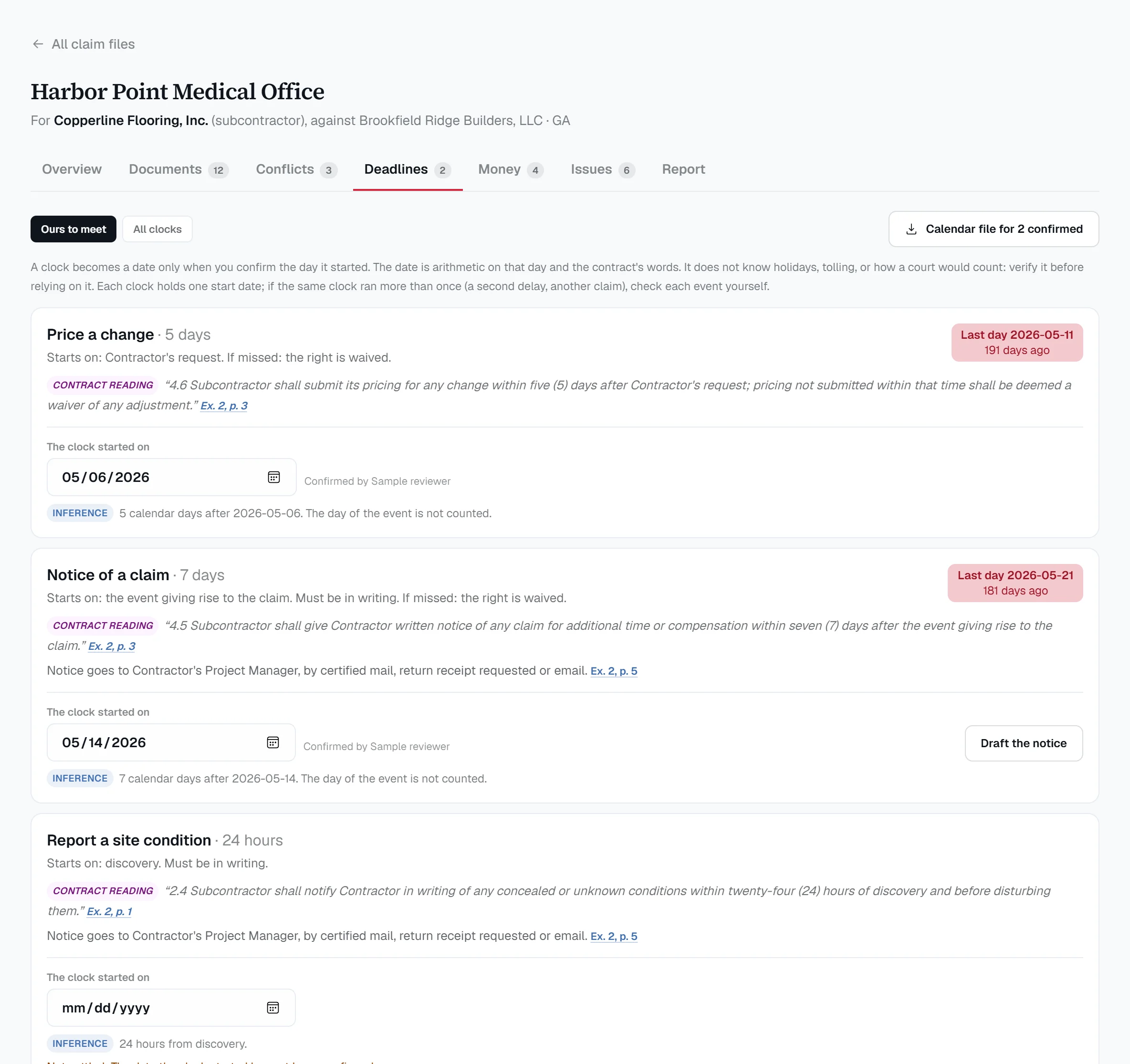
Notices and deadlines
Every clock in the contract, as a date you confirmed.
- 1
From the contract's own words
What starts each clock, how long it runs, whether it must be in writing, what happens if it lapses, and who notice goes to and how. - 2
A date only when you confirm one
Nothing is guessed. Until you confirm the day a clock started, it shows what is missing instead of a date. - 3
The arithmetic shows its work
Calendar or business days, the weekend, the hours, and what the software cannot know: holidays, tolling, how a court would count. - 4
Drafted, never sent
A notice draft quotes the clause and names the delivery method. A calendar file holds only the deadlines you confirmed.
Claims and defenses
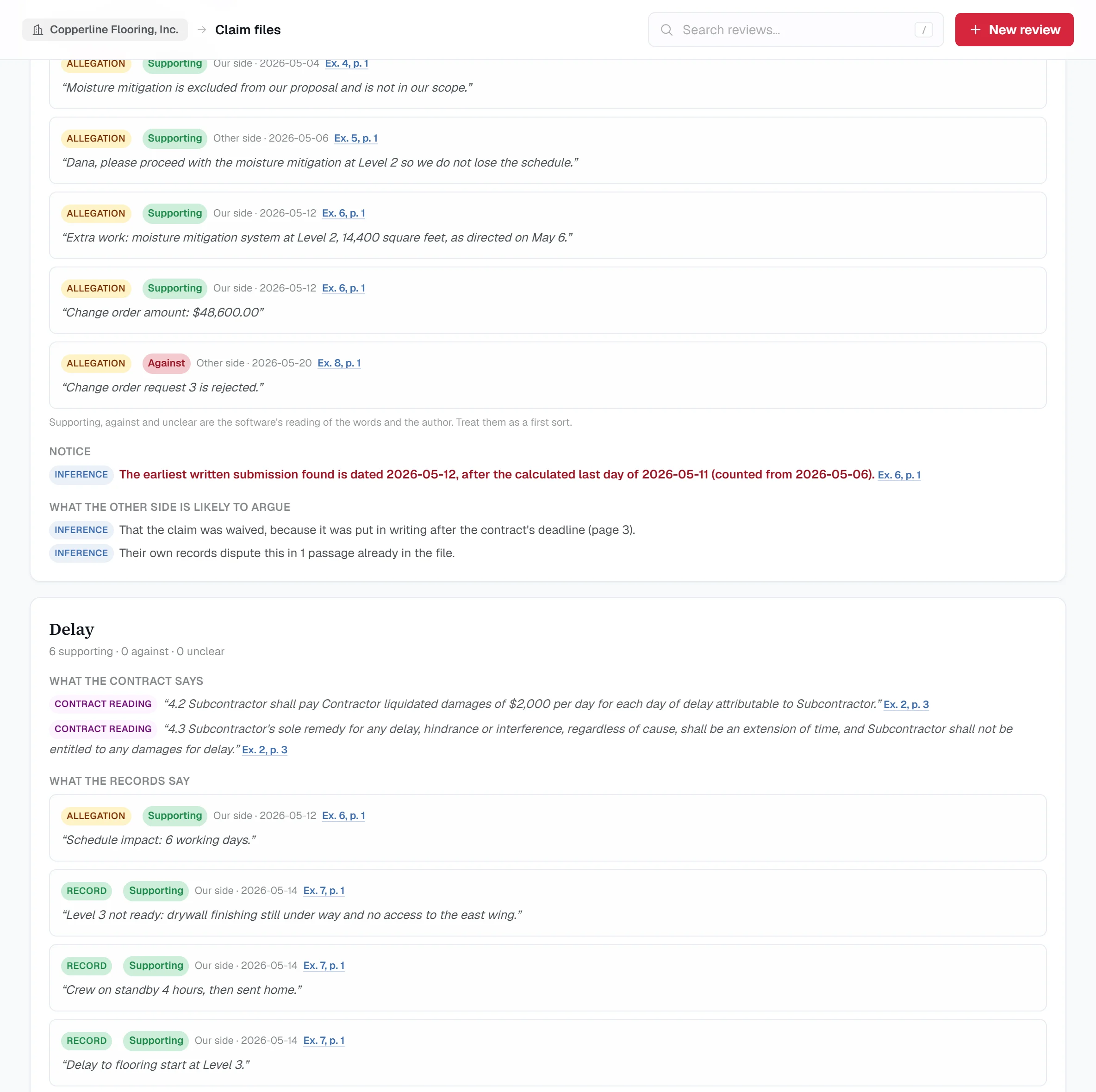
What the records say about each dispute, sorted by who wrote them.
For unpaid work, retainage, scope changes, delay, acceleration and backcharges, the file pulls together the contract language, the passages in each side's records, and whether written notice went out in time.
It lists the records a file on that issue would normally hold and does not, and what the other side is likely to argue from the gaps, so there are no surprises at the table.
Passages are found by their words, without AI, so the same records always give the same list. Something said in other words is missed.
The report
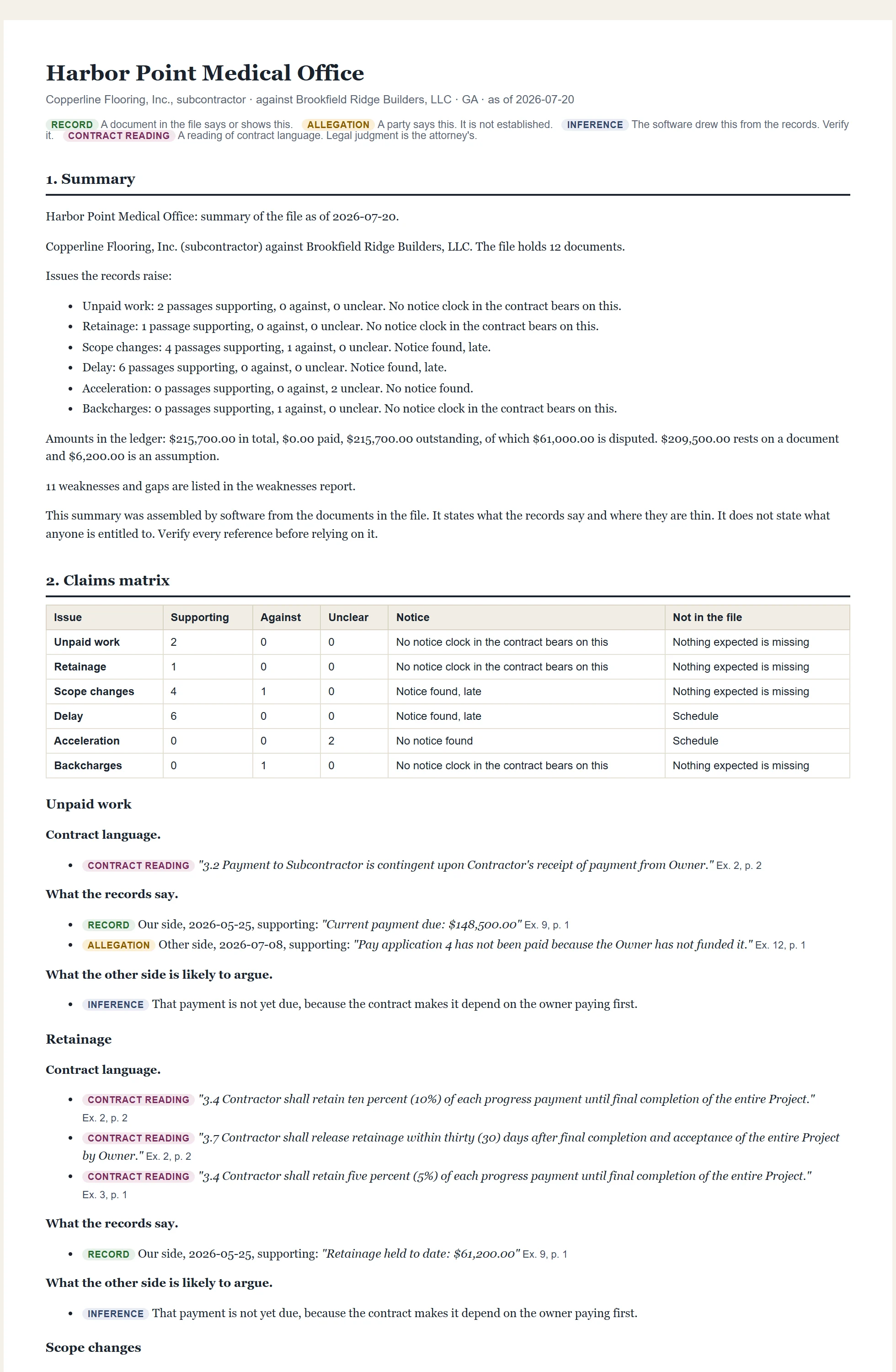
A claims matrix, a chronology and an exhibit index, ready for counsel.
One document: a summary you rewrite, the claims matrix, the amounts, the chronology, the weaknesses, the deposition questions the records raise, and the exhibit index. Every line names its exhibit and page. It prints to PDF and opens in Word.
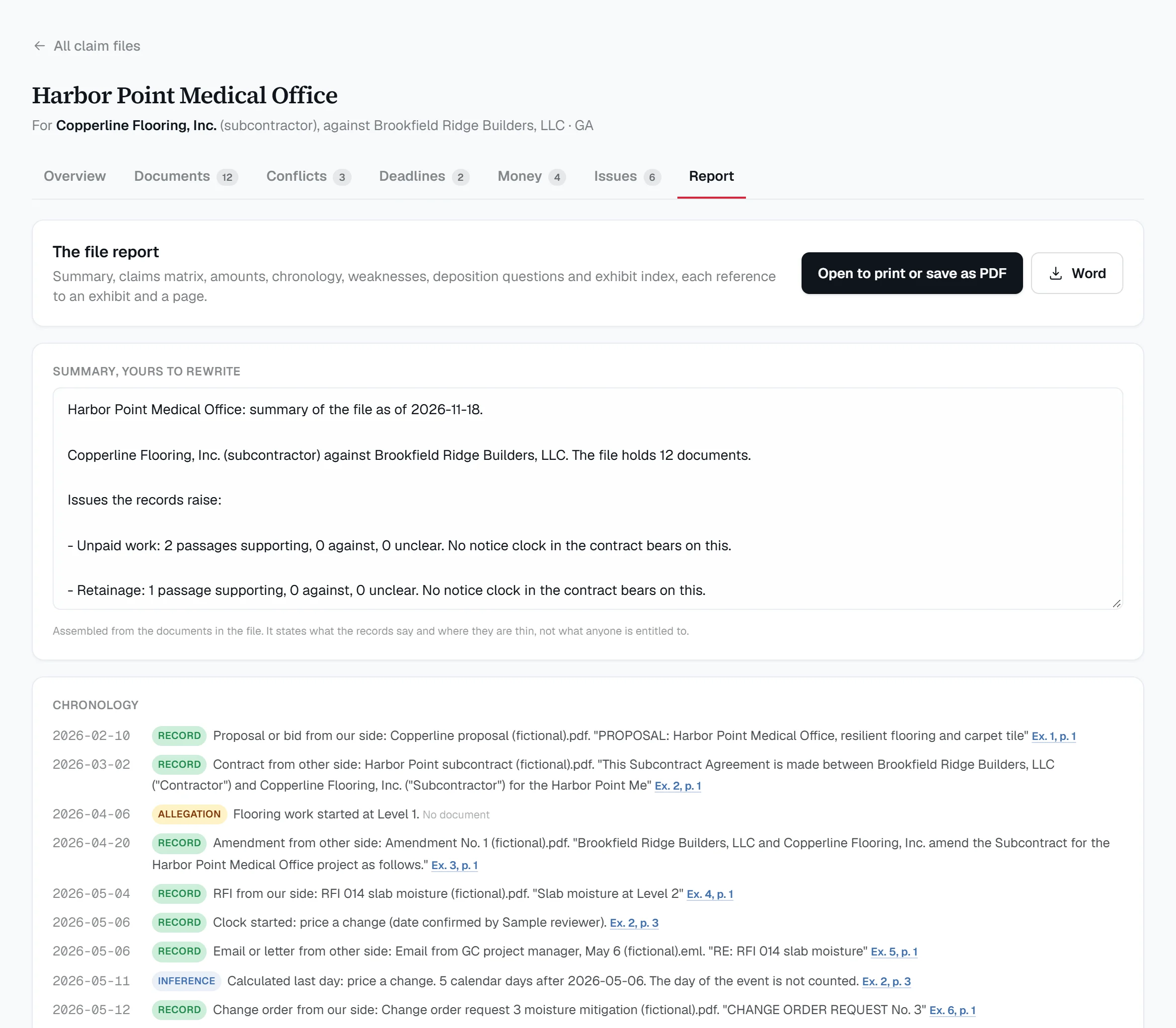
Every line, labelled
It keeps apart what the records show, what a party says, and what the software thinks.
A document in the file says or shows this.
A party says this. It is not established.
The software drew this from the records. Verify it.
A reading of contract language. Legal judgment is the attorney's.
Nothing in a claim file says what anyone is entitled to, or how a dispute will come out. It says what the paper shows and where it is thin.
Where it stands
What it does not do yet.
- Self-serve.
- Start the two free claim files from your Redline workspace, and subscribe there when you want more. Cancel any time; your files are kept.
- It reads words, not meaning.
- No AI reads a claim file yet. That makes it repeatable and impossible to steer, and it means anything said in other words is missed.
- One start date per clock.
- If the same clause ran twice (a second delay), check the second event yourself.
- PDFs, text and saved emails.
- Scanned PDFs with no text, Outlook .msg files and attachments inside emails are not read yet.
- Not legal advice.
- Redline is not a law firm. The report is preparation for the people who decide, and it says so on every page.
- Who can open a file.
- A file can be limited to named people in your company. Everyone else does not see it at all.
Run one real project through it.
Pick a job with a signed contract and a few months of records. The first two claim files are free, from your Redline workspace. After that it is $399 a month, added to your plan.
- Two claim files free, up to 60 documents in each
- Then $399 a month, added to any Redline plan, cancel any time
- Your records stay in your company's workspace and are never used to train AI
An attorney? Redline for construction attorneys shows claim files kept per client.